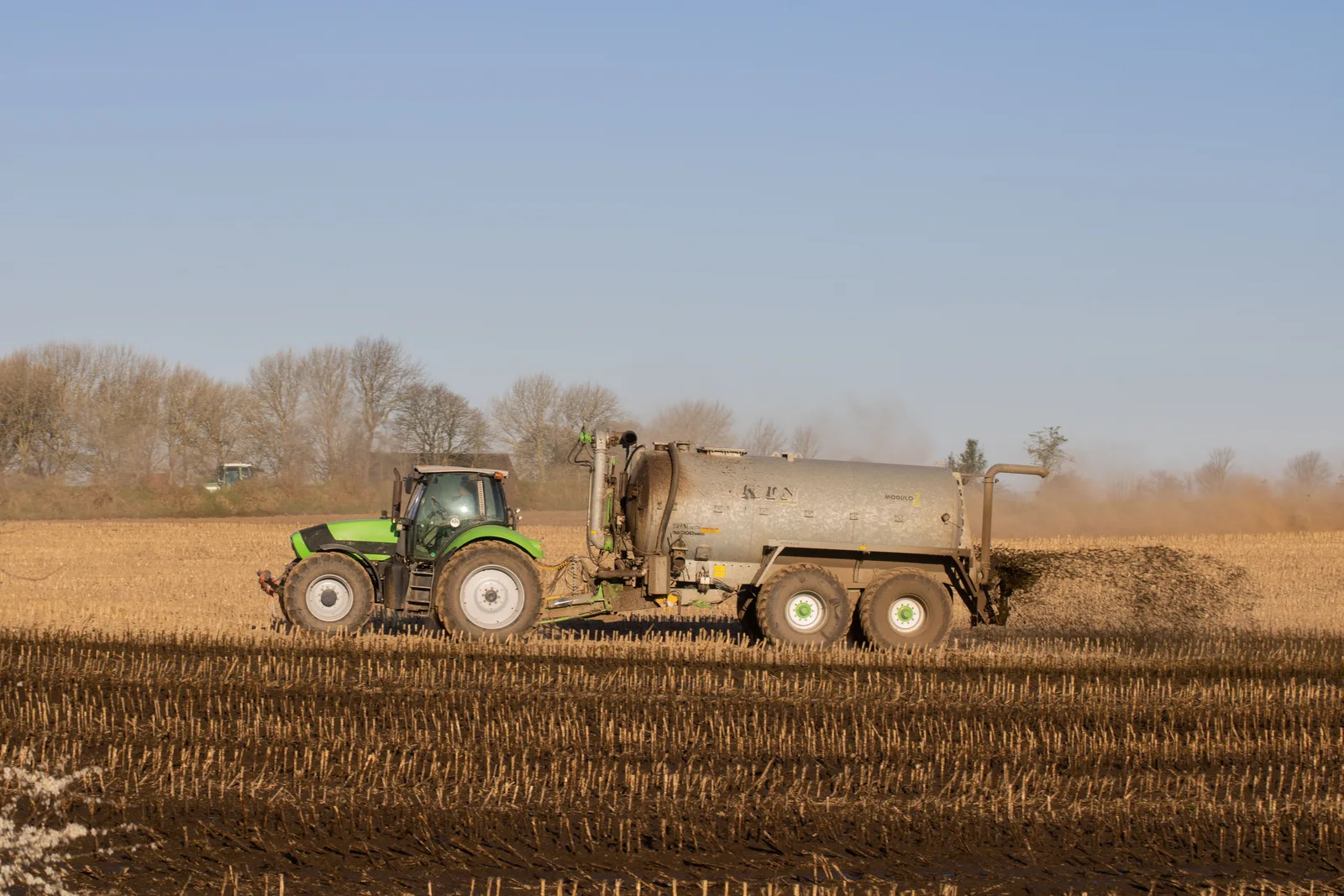
The first dates land on Tuesday. If any of your ground sits inside a Nitrate Vulnerable Zone, the autumn closed periods — the stretches when you must not spread — start rolling in from 1 September, and they do not all start together. They turn on three things: whether the land is grassland or tillage, whether the soil is sandy or shallow, and whether you are spreading manufactured fertiliser or a manure with high readily available nitrogen.
Here they are, straight from the GOV.UK guidance, with nothing added.
Manufactured nitrogen fertiliser
- Tillage land: 1 September to 15 January
- Grassland: 15 September to 15 January
Organic manures with high readily available nitrogen
That means slurry, poultry manure, digestate and liquid sludges — anything where more than 30% of the total nitrogen is available to the crop at the time of spreading. Farmyard manure and compost are not in this group.
- Tillage land, sandy or shallow soil: 1 August to 31 December
- Tillage land, all other soils: 1 October to 31 January
- Grassland, sandy or shallow soil: 1 September to 31 December
- Grassland, all other soils: 15 October to 31 January
There is one exemption written into the rules for the earliest of those: if you sow a crop on sandy or shallow tillage land on or before 15 September, you may apply high readily available nitrogen manures between 1 August and 15 September inclusive.
The rule that catches people after the gate reopens
The closed period ending is not a green light to empty the store. From the end of the closed period until the end of the following February, a single application may not exceed 30 m³/ha of slurry or 8 tonnes/ha of poultry manure, and there must be at least three weeks between applications. Plenty of otherwise careful farms trip over that one in a wet February.
And the N-max ceiling behind all of it
Separately from the dates, each crop carries an annual nitrogen limit you plan the whole year around — 220 kg/ha for autumn or winter sown wheat, 250 kg/ha for winter oilseed rape, 300 kg/ha for grass, and 0 kg/ha for field beans and peas, which fix their own.
Working it out for your own ground
Our NVZ Compliance Calculator holds the closed-period table alongside the livestock nitrogen loading and slurry storage checks, so you can see which dates apply to your fields instead of reading all of them. If the question underneath is how much nitrogen the crop actually needs, the Fertiliser & Nutrient Calculator answers that from AHDB's own RB209 engine; if it is whether pH is holding the field back before you spend on nitrogen at all, the Lime Requirement Calculator takes ten seconds. All free, no account needed — and the rainfall tracker is worth a glance before you plan travel on the ground.
Sources
- GOV.UK — Using nitrogen fertilisers in nitrate vulnerable zones
- GOV.UK — Nitrate vulnerable zones (guidance collection)
- The Nitrate Pollution Prevention Regulations 2015
This is a summary, not advice. The closed periods, exemptions and record-keeping duties are set out in full in the GOV.UK guidance and the 2015 Regulations — check them against your own land, and speak to a FACTS qualified adviser about your nutrient plan.